Deep Cavity Treatment: When Do You Need a Root Canal vs. a Filling?
You have a toothache. It might be a sharp zap when you drink cold water, or a dull throb that keeps you up at night. You come to the dentist hoping for a simple filling, but you are terrified of hearing the words: "You need a Root Canal."
At Deshpande Dental Care & Implant Centre, we understand this anxiety. The difference between needing a simple filling and a root canal often comes down to just a few millimeters of decay.
Here is a guide by Dr. Rucha Deshpande (MDS Conservative Dentist & Endodontist) to help you understand what your symptoms mean and how we decide on the treatment.
The Anatomy of a Cavity
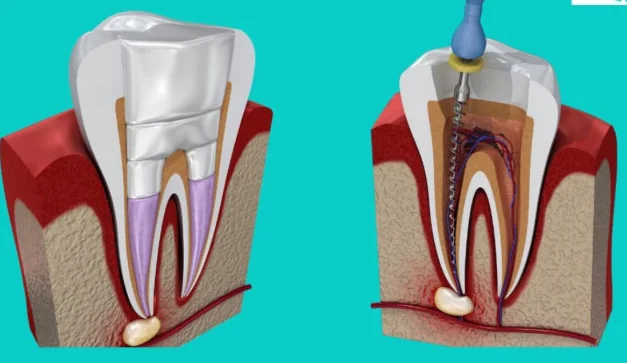
To understand the treatment, you have to understand the tooth layers:
- Enamel: The hard, white outer shell. (No sensation).
- Dentin: The softer, yellow middle layer. (Sensitive).
- Pulp: The innermost core containing nerves and blood vessels. (The source of pain).
Decay starts at the top. The treatment depends entirely on how deep the bacteria have traveled.
Scenario 1: The Simple Filling (Reversible Pulpitis)
If the decay is only in the Enamel or Dentin, the nerve is irritated but still healthy. This is called "Reversible Pulpitis."
-
Symptoms:
- Sensitivity to sweets or cold water.
- Pain disappears immediately after you swallow the cold drink.
- No pain at night.
-
The Treatment: Composite Filling. Dr. Rucha cleans out the decay and fills the hole with a tooth-colored material. The nerve heals itself, and the sensitivity stops.
Scenario 2: The "Grey Area" (Vital Pulp Therapy)
What if the decay is very deep, almost touching the nerve, but the nerve is still alive? In the past, dentists would just do a root canal. Today, we try to save it.
-
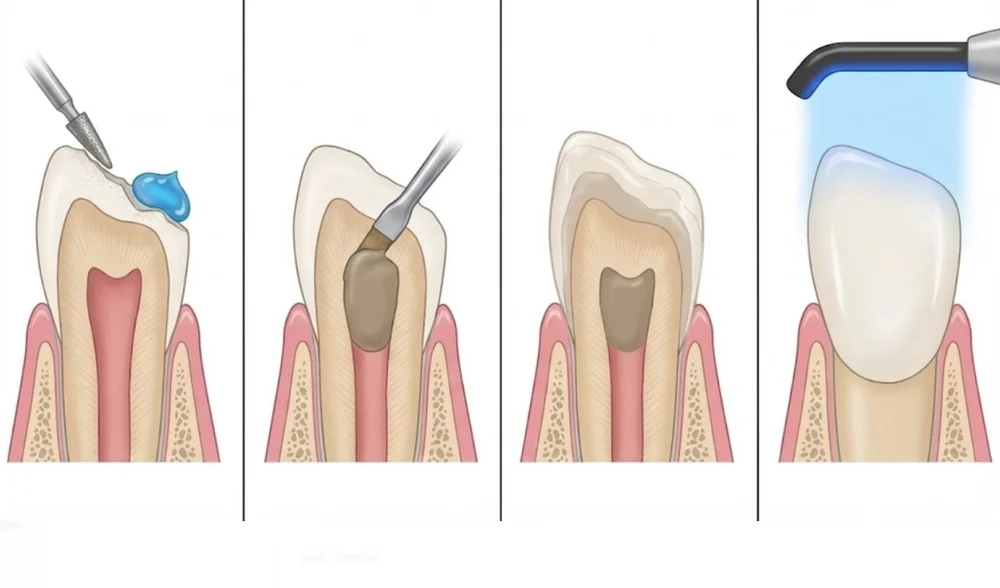
The Treatment: Pulp Capping.
- Dr. Rucha carefully removes the decay.
- She places a special bio-active medicine (like Calcium Hydroxide or MTA) over the deep spot to "insulate" and heal the nerve.
- A filling is placed on top.
-
The Goal: To soothe the nerve and avoid a root canal entirely.
Scenario 3: The Root Canal (Irreversible Pulpitis)
If the bacteria have breached the Pulp, the nerve gets infected and starts to die. Once the nerve is infected, it cannot heal itself. It must be removed, or the infection will spread to the bone (abscess).
-
Symptoms:
- Severe, spontaneous pain (throbbing without touching it).
- Pain that wakes you up at night.
- Lingering pain (it hurts for minutes/hours after drinking something hot or cold).
- Pain when chewing or tapping the tooth.
- A pimple on the gums.
-
The Treatment: Root Canal Therapy (RCT). Dr. Rucha removes the infected nerve tissue, disinfects the hollow canals, and seals them. This saves the natural tooth structure while removing the source of the pain.
Symptom Checker: What Do You Have?
| Symptom | Likely Problem | Likely Treatment |
|---|---|---|
| Pain only with sweets/cold | Cavity in Dentin | Filling |
| Pain goes away instantly | Reversible Pulpitis | Filling |
| Throbbing pain at night | Infected Nerve | Root Canal |
| Pain with Hot Coffee | Dying Nerve | Root Canal |
| Swelling / Pimple on Gum | Abscess | Root Canal |
Dr. Rucha's Philosophy: "Preservation First"
As a specialist in Conservative Dentistry, Dr. Rucha's primary goal is to keep your teeth vital (alive).
"I always check if the nerve can be saved. If a patient comes in with deep decay but no history of night pain, I will often attempt a Pulp Cap first. We have saved hundreds of teeth from root canals simply by using the right bio-materials and being gentle."
Conclusion
The earlier you catch a cavity, the higher the chance it stays just a filling. Waiting until it hurts at night usually guarantees a root canal.
Don't wait for the throb. If you feel a twinge of sensitivity, book an appointment at Deshpande Dental Care (Civil Chowk or Jule Solapur) immediately. We might be able to save your nerve today.